THE MILLION-DOLLAR LIFE THAT MOLD TOOK AWAY

There are no walls around Johnny Ray Hudson when he goes to sleep.

There is no bedroom door to close. No central heating. No hallway leading to a bathroom. No ordinary roof separating him from the night.

There is a hammock.

There are tarps.

There are batteries and solar panels, masks and supplies, water and whatever equipment can be made to work outside on a remote piece of land in rural western Spain.

This is home now.

It would be easy to look at Hudson's present life and imagine that he had always existed somewhere near society's edge.

The photographs say otherwise.

So do the bank statements.

So do the business records.

So do hundreds of thousands of people who once belonged to an online community he built.

Twenty years ago, Hudson's life was almost defined by movement. He photographed events. He worked rallies and resorts. He sold merchandise. He traveled. He fished with his father. He built businesses and spent his days around customers, friends and family.

Then came illness.

And eventually, almost everything that constituted an ordinary life became something he says his body could no longer tolerate.

The story Hudson tells begins with mold.

But the documents he has accumulated over the years tell a larger story—about illness, uncertainty, housing, disability and what happens when a person's medical needs no longer fit comfortably inside the systems designed to help him.

It is also the story of an astonishing reversal.

In 2020, Hudson was running a business through which more than $1 million in deposits and credits moved in a single year.

Today, he lives in a field.

THE LIFE BEFORE

Before there were medical reports, respirators and hospital correspondence, there were photographs.


Lots of them.


Hudson preserved an enormous visual record of his former life: family gatherings, friends, motorcycles, fishing trips, sporting events, resorts, photography jobs and businesses.


One image shows signage for Burleson Photo Company.


Others show a man seemingly everywhere—working, traveling, socializing, building things.


He was an entrepreneur long before Free Pipe Friday.


He worked as a photographer and vendor, photographing events and selling products at rallies, sporting events and other gatherings. He remembers a life filled with people.


And he remembers fishing with his father.


That version of Hudson matters because his current existence is so radically different that, without the photographs, it can sound almost impossible.


The photographs do not prove what later made him sick.


They establish something more basic.


There was a before.


And it looked nothing like this.


THE HOUSE


Hudson says the first warning was coming from inside his own body.


He began coughing up dark material.


At first, he blamed cigarettes.


So he quit smoking. He stopped drinking for a period as part of his effort to quit. He expected the problem to improve.


According to Hudson, it became worse.


His attention eventually shifted toward his father's Texas home, where he says extensive mold was discovered.


Hudson recalls his father spending approximately $20,000 attempting to remediate and renovate the property.


His father believed the problem had been solved.


Hudson says he still couldn't tolerate the house.


At one point, he remembers pulling away sheetrock near a doorway and discovering mold that had remained concealed behind it.


For Hudson, it became a dividing line.


The house was no longer simply a house.


It was somewhere he believed he could not safely live.


Eventually, father and son left.


And among the hundreds of images Hudson has preserved is a photograph from November 2016.


It shows the inside of a shipping container.


The caption is painfully casual:


“Me and my dad living in a shipping container. Love being homeless. Making do.”


It reads differently a decade later.


Because the shipping container wasn't the end of the story.


It was an early preview.

HE BUILT A MILLION-DOLLAR BUSINESS ANYWAY

Illness did not immediately destroy Hudson's ability to work.


That is one of the most important—and easily misunderstood—parts of his story.


He kept going.


In 2017, he started Free Pipe Friday.


The concept grew into an online retail operation surrounded by an enormous social-media community.


Hudson says its Facebook community exceeded 400,000 members at its peak. A surviving screenshot supplied for this article still shows 379,000 members.


Other surviving Free Pipe Friday pages show tens of thousands of followers.


One shows 32,000 followers and a 98 percent recommendation rate across 720 reviews.


Another shows 47,000 followers and a 98 percent recommendation rate across 2,085 reviews.


But social-media numbers can be ephemeral.


Bank statements are harder to dismiss.


Hudson's Wells Fargo statements identify the account holder as:


JOHNNY R HUDSON

DBA FREE PIPE FRIDAY.


In January 2020, the account recorded $49,936.89 in deposits and credits.


By March, the monthly figure had climbed to $116,731.06.


April recorded $148,810.74.


May: $195,136.30.


The complete set of statements Hudson supplied shows more than $1 million in deposits and credits during 2020.


That figure should not be confused with audited gross sales. Bank deposits can include transfers and other credits.


But the statements leave little doubt about the scale of the operation.


Individual transactions are repeatedly identified as bank-card merchant deposits for Free Pipe Fridays. The same records show payments for packaging, postage, shipping services, merchant processing and other costs consistent with a substantial mail-order business.


Hudson had built something.


And he had built it while already struggling with illness.


That changes the meaning of everything that came afterward.


He didn't simply stop working when life became difficult.


He built harder.


Until, he says, he couldn't anymore.
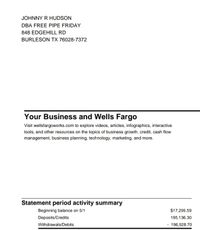
A May 2020 Wells Fargo business statement for Johnny R. Hudson, DBA Free Pipe Friday, shows $195,136.30 in deposits and credits for the statement period. The statement is part of the financial record documenting the scale of the business Hudson operated before severe illness transformed his life.

Johnny Ray hudson

The Free Pipe Friday Facebook community reached enormous scale. This surviving screenshot documents 379,000 members, illustrating the audience Hudson had built around the business before severe illness changed the course of his life.

Johnny Ray Hudson

I want to thank Ron and James for helping me master DJing.

Johnny Ray Hudson 

THE WORLD BEGAN TO SHRINK

As Hudson describes it, his illness progressed exposure by exposure.


Places other people entered without thinking became increasingly difficult for him.


Buildings.


Vehicles.


Shops.


Offices.


Eventually, even medical facilities.


He left the United States for Britain.


Then came another house.


In May 2020, during the first chaotic months of the COVID-19 pandemic, Hudson moved into a property at 74 Kingsthorne Park in Liverpool.


The dispute began almost immediately.


Hudson believed there was a damp and mold problem and said he was becoming ill inside the property. He hired North West Damp Detectives and began corresponding with his landlords and Liverpool City Council.


The documentary record here is important precisely because it isn't one-sided.


The landlords disputed Hudson's assessment. They cited an inventory describing the house as being in excellent condition and said there was no significant surface mold.


The damp investigator himself later wrote that there was no general evidence of surface mold and that mold could be present behind boarding, but proving that would require opening walls or ceilings. He advised Hudson that his legal position was weak and suggested that moving might be the better option.


Hudson replied that there was visible mold in the shower.


The landlords offered to terminate the tenancy early.


Hudson contacted the city.


On May 27, 2020, Liverpool City Council Senior Compliance Officer Rob Cain wrote that he had reviewed the move-in inventory, Hudson's commissioned report and another inspection report.


The Council declined to investigate further, saying there was insufficient evidence that the property was excessively damp or moldy compared with the national average.


The following day, Cain reiterated that the evidence did not suggest hazardous levels of damp and mold growth were significantly more likely there than in another property of the same age and type.


Hudson was left with two realities.


The authorities and property owners did not accept his interpretation of the house.


And Hudson said he could not remain inside it.


So he began sleeping outdoors.


Eventually, he left.


THE BUSINESS WAS STILL THERE. HIS BODY WASN'T COOPERATING.

This is where the timeline becomes difficult to comprehend.


While Hudson was dealing with housing instability and worsening environmental intolerance, Free Pipe Friday was moving enormous amounts of money.


The business hadn't failed because nobody wanted what he sold.


The community hadn't disappeared.


Customers were still ordering.


The machine Hudson had built was still moving.


But the man operating it says he was increasingly unable to participate in the physical world required to keep it alive.


Warehouses, packages, products, transportation, workplaces and people all came with environments he increasingly struggled to tolerate.


Eventually, the business declined.


A surviving post on one of Free Pipe Friday's Facebook pages begins with Hudson explaining to the very community he had created:


“I am the owner of Free Pipe Friday. Due to a severe chronic illness called Multiple Chemical Sensitivity (MCS), I lost my ability to…”


The sentence almost serves as an epitaph for the business.


Hudson had spent years building an audience.


Now he was explaining why he could no longer serve it.

WHAT THE SCIENCE CAN SAY

Hudson believes mold exposure began the cascade that ultimately destroyed his former life.


That belief needs to be separated from what medicine can presently establish.


Damp and moldy buildings are associated with recognized health effects. The U.S. Centers for Disease Control and Prevention says people exposed to damp or moldy environments may experience respiratory and allergic symptoms, and exposure can aggravate asthma.


The World Health Organization has likewise concluded that persistent dampness and microbial growth in buildings should be prevented or remediated because of their associations with adverse health effects.


That evidence does not, however, establish that one particular mold exposure caused every subsequent medical problem Hudson experienced.


Multiple Chemical Sensitivity itself remains medically complex and contested in questions of mechanism and causation.


Even an official Spanish public-health protocol included in Hudson's records acknowledges uncertainty surrounding its pathogenesis while providing practical recommendations for treating people who report severe chemical intolerance.


That distinction is crucial.


The origin may be debated.


Hudson's present disability is documented.


97 OUT OF 100


Years after the first house, the shipping container, England and the collapse of his ordinary indoor life, Hudson finally obtained a specialist assessment in Spain.


The numbers are stark.


On the QEESI—the Quick Environmental Exposure and Sensitivity Inventory—Hudson's specialist report recorded:


92/100 for symptom severity.


97/100 for inhaled chemical intolerance.


89/100 for impact on daily life.


The specialist classified his Multiple Chemical Sensitivity as Grade IV/IV. The report described symptoms associated with exposure to gases, disinfectants, perfumes and cleaning products and documented his near-continuous use of respiratory protection and change of residence.


The recommendations included avoiding irritants and toxic exposures, adapting personal, social and work activities, and implementing specific safety measures in environments with high chemical loads—including hospitals and operating rooms.


The report described significant limitations affecting activities of daily living and work.


For years, Hudson had been trying to explain why ordinary places had become extraordinary obstacles.


Now a specialist had put numbers beside the experience.


But diagnosis did not give him his life back.


And it did not solve perhaps the most frightening problem of all.

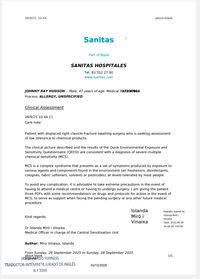
A September 2025 clinical assessment from Sanitas states that Johnny Ray Hudson’s clinical picture and QEESI results were consistent with severe Multiple Chemical Sensitivity (MCS). The physician documented low tolerance to chemical products and advised “extreme precautions” when Hudson must attend a medical center or undergo surgery.

JOHNNY RAY HUDSON 

WHAT IF THE PLACE THAT IS SUPPOSED TO SAVE YOU IS A PLACE YOU CANNOT TOLERATE?

On July 1, 2025, Hudson injured his shoulder.


Medical evaluation documented a displaced clavicle fracture.


Surgery was considered.


A private hospital in Cáceres scheduled an operation for August.


Then it was postponed.


Subsequent correspondence from the hospital's medical director described increased surgical and anesthetic risk and recommended treatment in a center with intensive-care capabilities.


The broken bone had created an almost perfect demonstration of Hudson's predicament.


He needed conventional medicine.


But conventional medicine takes place indoors.


Hospitals contain disinfectants, cleaning agents and other environmental exposures that his specialist documentation says should be minimized.


By December 2025, according to correspondence incorporated into Hudson's administrative claim, his insurer reported that after contacting public and private hospitals in Extremadura, it had been informed that no center could perform his clavicle surgery under the technical and environmental conditions involved. Treatment might have to occur in another province.


Then, in January 2026, the Extremadura Health Service responded.


It acknowledged Hudson's displaced clavicle fracture.


It acknowledged his Grade IV Multiple Chemical Sensitivity.


It acknowledged the complexity involved in surgery and the importance of safe, adequate and equitable medical care.


And it acknowledged something else:


The regional health service had no specific MCS protocol.


The health service said the case would be referred for coordinated analysis and that known measures for safer management could be considered.


For Hudson, however, the fundamental problem remained.


He had spent years being told to seek medical help.


Now he possessed documents illustrating how difficult accessing that help could actually be.


A LIFE OUTSIDE

Hudson eventually settled on rural land in Extremadura, near Spain's border with Portugal.


He lives outdoors.


Not metaphorically.


Not as a description of someone who spends most of his day outside.


Outdoors.


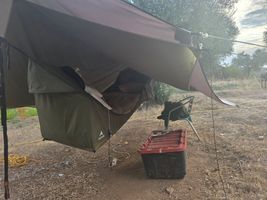
His sleeping space is a hammock beneath tarps.


Electricity comes from solar panels and batteries.


Water, food, weather, equipment failure and transportation become daily logistical problems that walls once made invisible.


Rain matters differently when rain is falling around the place where you sleep.


Winter matters differently.


Heat matters differently.


A broken vehicle matters differently when getting into another enclosed vehicle can itself present a problem.


Illness has transformed ordinary conveniences into engineering challenges.


Hudson has improvised an existence around what his body will tolerate.


But improvisation should not be confused with recovery.


He did not move into a field because it represented his dream retirement.


He moved progressively farther outside because, in his account, the number of environments he could tolerate kept getting smaller.

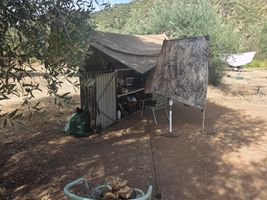
Hudson’s outdoor living area in rural Spain. Tarps, open-sided shelters and improvised work and living spaces have replaced the conventional home and business environments that once defined his daily life. Medical records document severe Multiple Chemical Sensitivity and substantial restrictions on everyday activities. For Hudson, remaining outdoors is not recreation—it...

JOHNNY RAY HUDSON 

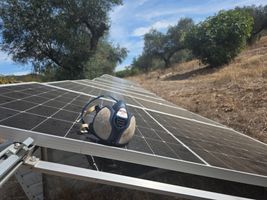
A respirator rests on the solar panels that power Johnny Ray Hudson’s outdoor life in rural Spain. After severe Multiple Chemical Sensitivity made ordinary indoor environments increasingly difficult for him to tolerate, Hudson built an unconventional life around open air, respiratory protection and off-grid solar power. His medical records document severe chemical intolerance...

Johnny Ray Hudson 

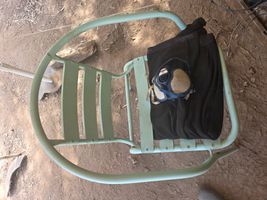
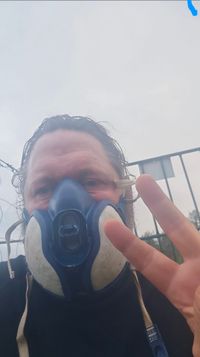
A respirator rests beside Hudson’s clothing at his outdoor living area in rural Spain. For Hudson, respiratory protection is not specialized equipment reserved for a workplace—it has become part of everyday life as he attempts to limit exposures documented as problematic in his medical assessments.

JOHNNY RAY HUDSON 

WHAT EXACTLY WAS LOST?

UseMoney is the easiest answer.


It is also the least important one.


Yes, the financial records matter.


They matter because extraordinary claims deserve documentation.


They show that Hudson once operated a business through which substantial amounts of money flowed.


The Facebook screenshots matter because they show scale.


The photographs matter because they show the social world surrounding him.


But the real loss is hidden between those pieces of evidence.


It is the ability to walk through a door without calculating what might be on the other side.


To get into a car.


To visit family.


To sleep in a bedroom.


To go shopping.


To work beside other people.


To enter a hospital because you are injured and assume that being inside the hospital is the safest part of the emergency.


To make plans based on what you want to do rather than what environment you might be able to tolerate.


Those are not million-dollar privileges.


Most of them cost nothing.


Until you lose them.

this space to develop your idea and move the story forward. Add details, examples, or observations that make your point clearer. Keep each paragraph focused around one idea. Add more sections to build your story step by step.


THE FATHER IN THE PHOTOGRAPHS

THE FATHER IN THE PHOTOGRAPHS


There is another presence running through Hudson's archive.


His father.


They traveled together.


They fished together.


They lived through the Texas house together.


They even ended up in that shipping container together.


Hudson believes the moldy environment harmed his father's health as well. His father later suffered serious cardiac problems and died years afterward.


There is no evidence in the records reviewed for this article establishing that mold caused his father's heart disease or death, and Hudson's belief should not be mistaken for a medical finding.


But causation is not necessary to understand the photograph.


Father and son were living in a shipping container.


Years later, the son would be living beneath tarps in Spain.


The repetition is haunting.

A CASE THAT COULD NOT GIVE HIM HIS LIFE BACK

Hudson's problems were not confined to medicine.


In Texas, he became involved in a criminal case. His attorneys challenged the search underlying it.


The surviving motion to suppress argued that the warrant lacked probable cause and challenged representations and omissions in the supporting affidavit.


A July 2018 email from his legal team told Hudson that a board-certified appellate attorney considered the suppression argument strong and that, if successful, it could affect all of his cases.


That email documents what Hudson was being told by his lawyers at the time.


It does not establish that the motion ultimately succeeded. The copy of the proposed order preserved in Hudson's records is unsigned, with neither “granted” nor “denied” selected.


Hudson says he spent tens of thousands of dollars on bond and lawyers.


He also says his deteriorating ability to tolerate indoor environments made participating in the legal process increasingly difficult.


Another piece of his former life had become dependent upon entering buildings.


THE QUESTION IS NO LONGER WHETHER JOHNNY HUDSON USED TO HAVE A LIFE


That part is documented.


The photographs document it.


The business records document it.


The bank statements document it.


The correspondence documents it.


The medical reports document what came later.


The unresolved question is how society handles someone whose disability does not fit easily into the physical infrastructure of ordinary life.


Hudson's Spanish administrative claim makes that problem explicit.


It does not claim that the Spanish health service caused his original clavicle fracture. Instead, it argues that his documented condition left him without an effective healthcare pathway compatible with his disability.


That is a narrower allegation.


It may also be the more consequential one.


Because Hudson will not always need treatment for a clavicle.


People get appendicitis.


They develop infections.


They have accidents.


They need imaging, surgery and emergency care.


A healthcare-access problem that remains unresolved while a patient is relatively stable can become something very different during an emergency.


Hudson's own filing is careful on this point: it does not claim that some future medical event will necessarily kill or permanently injure him.


It asks what will happen when that event eventually comes.


THE MILLION-DOLLAR LIFE

There is a temptation to make Hudson's story about the million dollars.


It makes a spectacular headline.


But the money isn't really the story.


The million dollars is evidence.


It tells us that this man once functioned at a level almost impossible to square with the life he lives now.


He managed customers.


He moved inventory.


He built communities.


He marketed products.


He shipped orders.


He handled money.


He solved problems.


He created something hundreds of thousands of people chose to join.


Then the radius of his life contracted.


From businesses and events—


to houses he struggled to inhabit—


to sleeping outside—


to searching for somewhere his body would tolerate—


to rural Spain—


to a hammock.


That is the distance between the photographs at the beginning of Hudson's archive and the life at the end of it.


AND TONIGHT

Tonight, the business account is no longer the thing that determines whether Hudson's day went well.


The questions are smaller now.


Is there enough power?


Is the weather coming in?


Does the water system work?


Can he get the supplies he needs?


Will the mask hold up?


What happens if he becomes seriously ill?


The man who once managed an online community approaching half a million people now spends much of his life physically separated from almost everyone.


The entrepreneur who moved more than $1 million through a business account in 2020 sleeps outside.


The photographer who spent years documenting other people's lives has inadvertently created an archive of his own disappearance from ordinary society.


Look through those photographs long enough and something unsettling happens.


You stop seeing a collection of old pictures.


You begin seeing evidence of everything a person can lose without dying.


A business.


A home.


A profession.


Friends.


Independence.


Family dinners.


Road trips.


A bedroom.


The unquestioned right to walk inside.


Hudson calls mold the beginning.


Science cannot reconstruct every link in that chain with certainty, and an accurate account of his life should not pretend that it can.


But neither can uncertainty erase what came afterward.


The million-dollar business existed.


The hundreds of thousands of community members existed.


The shipping container existed.


The Liverpool correspondence exists.


The Grade IV/IV diagnosis exists.


The 97-out-of-100 inhaled-intolerance score exists.


The hospital problem exists.


And the hammock exists.


That may be the most difficult part of Johnny Hudson's story.


Not that everything about what happened to him can be neatly proven.


But that so much of what happened can.


And when night falls over the Spanish countryside, the evidence ultimately leads back to one man beneath a tarp—surrounded by the remains of a life he once spent years building.


A million-dollar life.


And no walls around him.


This is where Johnny Ray Hudson sleeps. A hammock suspended beneath tarps serves as his bedroom in rural Spain, where he lives outdoors because of severe Multiple Chemical Sensitivity. Medical documentation describes severe chemical intolerance, major limitations on daily life and the need to avoid environmental triggers. What appears temporary is, for Hudson, daily lif...

JOHNNY RAY HUDSON 

MCS Survival Foundation works to raise awareness and advocate for people living with severe Multiple Chemical Sensitivity. Share this story to help make invisible barriers visible..

JOHNNY RAY HUDSON

More Posts

U.S. CITIZEN IN DISTRESS: AN AMERICAN IS DYING IN A FIELD IN SPAINU.S. CITIZEN IN DISTRESS: AN AMERICAN IS DYING IN A FIELD IN SPAIN
U.S. CITIZEN IN DISTRESS: AN AMERICAN IS DYING IN A FIELD IN SPAIN

He is severely disabled. He lives outdoors. He says ordinary buildings can make him dangerously ill, appropriate medical care has become extraordinarily difficult to access, and organization after organization has told him his circumstances are beyond what they can handle. He has asked governments, hospitals, charities, disability groups, churches, friends and family for help. The explanations change. The American remains in the field.

SANTIAGO DE ALCÁNTARA, Spain —

An American citizen is living in a field in Spain.

Read that sentence again.

Not camping.

Not backpacking.

Not spending a summer beneath the stars.

When Even the Hospital Is Out of ReachWhen Even the Hospital Is Out of Reach
When Even the Hospital Is Out of Reach

Johnny Ray Hudson has Grade IV Multiple Chemical Sensitivity. His doctor says hospitals and operating rooms require special environmental precautions. But in a nation with roughly 6,100 hospitals, a deep search of the public record turned up only three U.S. institutions known to have developed dedicated MCS protocols—and every one of those records is more than two decades old.

SANTIAGO DE ALCÁNTARA, Spain — If Johnny Ray Hudson suffers a heart attack tonight, conventional medical advice is simple.

Get to a hospital.

If he suffers a stroke, get to a hospital. If he falls and fractures another bone, get to a hospital. If a wound needs stitches, if an infection turns dangerous, if abdominal pain becomes a surgical emergency, if he needs imaging, medication, oxygen, anesthesia or intensive care, the answer is supposed to remain the same.

A Broken Bone, a Suspected Disease, and a Health System That Couldn’t Treat BothA Broken Bone, a Suspected Disease, and a Health System That Couldn’t Treat Both
A Broken Bone, a Suspected Disease, and a Health System That Couldn’t Treat Both

His clavicle needed surgery. Doctors suspected Multiple Chemical Sensitivity and required further medical evaluation before the operation could proceed. The diagnosis was ultimately confirmed as severe, Grade IV MCS. But the diagnosis did not return Johnny Ray Hudson to the operating room. More than a year later, the documents surrounding his case tell a larger story about what happens when medical care exists — but a disabled patient cannot reliably access it.

About This BlogAbout This Blog
About This Blog
We write for customers, neighbors, and anyone interested in what we do and how we do it. This is a place to stay connected, learn something new, and get a closer look at what’s happening around our business.

JOHNNY RAY HUDSON | yesterday

The Million-Dollar Life That Mold Took Away

Johnny Ray Hudson built businesses, photographed events, traveled with his father and created an online community numbering in the hundreds of thousands. In 2020, more than $1 million in deposits and credits moved through his Free Pipe Friday business account. Today, he sleeps in a hammock beneath tarps in rural Spain, living almost entirely outdoors with severe Multiple Chemical Sensitivity.

A Special Report