A Broken Bone, a Suspected Disease, and a Health System That Couldn’t Treat Both
His clavicle needed surgery. Doctors suspected Multiple Chemical Sensitivity and required further medical evaluation before the operation could proceed. The diagnosis was ultimately confirmed as severe, Grade IV MCS. But the diagnosis did not return Johnny Ray Hudson to the operating room. More than a year later, the documents surrounding his case tell a larger story about what happens when medical care exists — but a disabled patient cannot reliably access it.
The broken bone
SANTIAGO DE ALCÁNTARA, Spain —
When darkness falls over the countryside of western Spain, Johnny Ray Hudson prepares to sleep outside.
Again.
There is no camping trip ending in the morning. No weekend adventure. No house waiting for him when the weather changes.
This is where he lives.
Beyond the rural land near Santiago de Alcántara are towns containing nearly everything a person is supposed to need to survive modern life.
Running water.
Toilets.
Supermarkets.
Government offices.
Doctors.
Hospitals.
The things Hudson needs exist.
Reaching them is the problem.
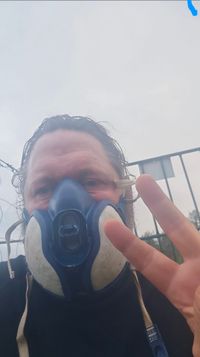
Hudson has severe Multiple Chemical Sensitivity, known in Spain as Sensibilidad Química Múltiple, or SQM. His specialist's records describe reactions associated with substances common to ordinary indoor life and advise extreme precautions when he enters medical facilities or undergoes surgery.
For Hudson, that creates a contradiction difficult to appreciate until something goes wrong.
A hospital may be available.
A patient may have insurance.
A doctor may know what treatment is required.
But none of those things guarantees that the patient can actually reach and tolerate the environment in which that treatment is delivered.
Hudson discovered that distinction through one of medicine's most ordinary emergencies.
He broke a bone.
And what happened next turned a fractured collarbone into a test of an entire healthcare system.
On July 1, 2025, Hudson sought emergency medical care after injuring his right shoulder.
Doctors found a displaced fracture of his right clavicle.
There was nothing mysterious about the injury.
The bone was broken. Medical imaging showed it. Surgical treatment was indicated.
Eventually, an operation was scheduled at Hospital Quirónsalud Cáceres for Aug. 6.
But between the broken bone and the operating room, another medical problem emerged.
On July 5, during an emergency visit at Quirónsalud Cáceres, the physician treating Hudson documented suspected Multiple Chemical Sensitivity.
That point is crucial to understanding everything that followed.
Hudson did not enter this sequence with a specialist-confirmed MCS diagnosis and demand that the hospital accommodate it.
The suspected condition was documented during his medical care.
Now the doctors had two problems in front of them:
a displaced clavicle fracture requiring orthopedic treatment,
and a suspected condition that could affect how that treatment could safely be delivered.
The second problem began overtaking the first.
Before they could operate, they needed answers
A broken clavicle has an established treatment pathway.
Suspected severe chemical sensitivity complicated it.
What medications could safely be administered?
What anesthetic considerations existed?
What environmental exposures needed to be controlled?
Could the operation safely be performed at that hospital?
What precautions would be necessary?
Those were no longer theoretical questions.
Hudson's surgery was approaching.
He began communicating extensively with Sanitas and Quirónsalud while attempting to obtain the medical evaluation necessary to clarify the suspected condition and move the operation forward.
The documentary record shows the urgency: in correspondence from July, Hudson repeatedly explained that he needed a diagnosis in connection with his scheduled surgery.
Then, on July 31, less than a week before the scheduled operation, Quirónsalud postponed it.
The hospital's subsequent formal account said the intervention had been postponed until necessary medical evaluations and other clinical, logistical and safety requirements could be completed.
The case required multidisciplinary assessment and an individualized approach.
The operation scheduled for Aug. 6 did not happen.
Hudson still had the broken clavicle.
And now the path back to the operating room ran through a diagnosis he did not yet have.
That is the next block to paste.
The fracture remained. The search for an answer began
What followed is important because it changes the meaning of Hudson's eventual MCS diagnosis.
He did not obtain that diagnosis in isolation from his fractured clavicle.
The unresolved surgery was part of the reason the diagnosis mattered.
Hudson continued working through Sanitas to obtain specialist evaluation.
Weeks passed.
Meanwhile, the hospital's position hardened.
On Sept. 9, Quirónsalud Cáceres put its assessment in writing.
The hospital said Hudson's surgical and anesthetic circumstances involved increased risk. It recommended that his treatment occur in a center with intensive-care capability.
But there was another important sentence:
Orthopedic surgical treatment remained indicated.
The bone still needed medical attention.
Quirónsalud Cáceres nevertheless concluded that it could not perform the operation because it could not guarantee the clinical, logistical and safety requirements involved.
The problem had fundamentally changed.
It was no longer:
Does Hudson need treatment?
It was:
Who can safely provide it?
Then came the diagnosis
Eventually, Sanitas directed Hudson to a specialist in Barcelona.
Her name was Dr. Iolanda Miró i Vinaixa.
Miró was not simply another physician being asked for a general opinion. Her records identify her as the physician responsible for the Central Sensitisation Unit.
Her Sept. 28 clinical assessment makes the connection to Hudson's unresolved orthopedic problem explicit.
It describes him as a:
“Patient with displaced right clavicle fracture awaiting surgery.”
Then came the answer to the medical question that had followed him since July.
His clinical presentation and results on the Quick Environmental Exposure and Sensitivity Questionnaire, or QEESI, were, Miró wrote, consistent with severe Multiple Chemical Sensitivity.
The detailed specialist assessment recorded striking scores:
97 out of 100 for inhaled chemical intolerance.
92 out of 100 for symptom severity.
89 out of 100 for impact on activities of daily living.
72 out of 100 for other intolerances.
And the classification was the highest level used in the specialist report:
Grade IV of IV.
The uncertainty surrounding the suspected condition had been replaced by specialist documentation.
Hudson had the answer.
But the answer did not solve the original problem.
He still needed medical care for the clavicle.
The diagnosis came with a warning
Miró's report did more than name the condition.
It addressed precisely the situation that had brought Hudson there.
Surgery.
Her assessment advised “extreme precautions” if Hudson needed to attend a medical center or undergo an operation.
She gave him three documents containing recommendations concerning medications and protocols for MCS, specifically to support the pending surgery and future medical procedures.
Spain itself has long recognized MCS as a complex healthcare problem. In 2011, the Spanish Ministry of Health presented a national consensus document intended to provide healthcare professionals with common guidance on diagnosis, management and multidisciplinary care. It identified avoidance of triggering exposures as an important measure and stressed that healthcare personnel should understand the particular requirements surrounding MCS patients.
Hudson now possessed what should have clarified the medical uncertainty.
A specialist diagnosis.
A severity classification.
Clinical measurements.
Recommendations for medical treatment.
Specific warnings concerning hospitals and surgery.
But the diagnosis did not unlock the operating room.
No hospital in the region was identified
Sanitas began searching.
According to documentation incorporated into Hudson's subsequent administrative case, by December 2025 inquiries had been made with public and private hospitals in Extremadura.
The result was extraordinary.
No regional center had been identified that could perform the clavicle surgery under the technical and environmental conditions involved.
Treatment might have to occur outside Extremadura.
For most patients, “outside the region” means traveling farther.
For Hudson, transportation can itself be part of the disability barrier.
A hospital hundreds of kilometers away does not solve the problem if reaching it requires exposure to environments the patient's medical documentation says should be avoided or carefully controlled.
The treatment may exist.
The pathway to it may not.
Even the ambulance became part of the story
Hudson's records show how quickly ordinary logistics became medical obstacles.
Sanitas correspondence at one point confirmed a traumatology appointment and said an ambulance would collect Hudson at an agreed location.
But another August episode, described in Hudson's complaint and accompanying correspondence, demonstrates how fragile such arrangements could become.
Hudson says that because an ambulance could not reach the isolated location where he was staying, he walked roughly 30 minutes across mountainous terrain with his fractured clavicle to reach the pickup point.
The ambulance did not arrive.
Later correspondence again arranged an appointment and ambulance pickup.
Hudson had insurance.
He had doctors.
He had appointments.
At times, he even had transportation arrangements.
What he did not have was a dependable chain connecting them.
Then the public healthcare system acknowledged the problem
Hudson continued asking for help.
By Jan. 22, 2026, the Servicio Extremeño de Salud, or SES, had addressed his Grade IV MCS and displaced clavicle fracture.
According to the documentary record, SES acknowledged the complexity of surgical care involving MCS, the need for safe and equitable treatment and the absence of a specific MCS protocol within the regional health service. The matter was to be directed toward relevant units and Patient Safety for coordinated analysis.
There was movement.
On paper.
But months passed.
In March, Hudson received information directing him toward a physician in Madrid.
According to his administrative filing, that communication did not establish an orthopedic surgical referral, designate an admitting hospital, establish an accessible radiology pathway or create an emergency-care plan.
By May, Hudson was still asking what had happened to his imaging and surgery and reporting continuing pain.
The record reviewed for this story does not show that those communications ultimately produced a coordinated orthopedic, radiological and surgical pathway.
His case was moving through the system.
Hudson was still outside it.
Spain knows this problem exists
This is where Hudson's story becomes larger than one patient.
Multiple Chemical Sensitivity is not an issue Spain's healthcare institutions have never encountered.
The Ministry of Health's national consensus document was published in 2011. Its stated purpose included helping healthcare professionals make decisions concerning diagnosis, therapeutic management and prevention, while encouraging comprehensive and multidisciplinary care.
And the records assembled in Hudson's case include more detailed Spanish healthcare guidance addressing severe MCS in clinical environments.
That guidance describes patients at the most severe level as potentially needing a mask almost continuously, changing residence because of their condition and becoming socially isolated.
It discusses reducing environmental triggers during medical treatment and controlled healthcare spaces sometimes referred to as “white areas.” The protocol addresses hospital admissions, emergencies and surgery.
So the question raised by Hudson's case is no longer simply:
Can severe MCS complicate healthcare?
Spain's own healthcare guidance already recognizes that it can.
The harder question is:
What happens when the patient actually arrives?
Seven years of unfinished work
In September 2026, another institutional response widened the story further.
Spain's Defensor del Pueblo relayed information from the Junta de Extremadura concerning regional work on central sensitization syndromes, including MCS.
According to documentation incorporated into Hudson's case, a multidisciplinary working group had been established in 2019 to develop protocols.
Drafts were produced.
Time passed.
Some of the material became outdated.
And the Junta reported that it did not then have sufficient personnel to reactivate the work with the required intensity.
2019 to 2026.
Seven years.
For an institution, seven years can be meetings, drafts, staffing shortages, revisions and competing priorities.
For the person waiting at the other end, seven years is measured differently.
It is seven years of life.
The collarbone isn't the story anymore
The fracture exposed the problem.
It didn't create it.
Hudson's condition follows him beyond the hospital into systems constructed around one assumption so ordinary that most people never notice it:
You can go inside.
Food is inside shops.
Government services are administered inside offices.
Medical imaging happens inside clinics.
Emergency medicine happens inside hospitals.
Public toilets are generally inside buildings.
Transportation usually requires entering an enclosed vehicle.
Shelter itself normally means going inside.
Hudson's specialist documented severe MCS and warned that extreme precautions were advisable when he entered medical facilities or underwent surgery.
The result is that complicated questions about medicine and administration become brutally simple questions about ordinary life.
Where does he get water?
Where can he safely use a toilet?
What can he safely live inside?
How does he travel?
Where does an ambulance take him when something happens tonight?
Those aren't really questions about a rare medical condition.
They are questions about how a human being is supposed to live.
Available is not the same as accessible
A hospital can exist without being practically accessible to every patient.
Water can be available without a person having a sustainable way to obtain it.
Housing can exist without being medically tolerable to a particular individual.
Transportation can exist while the environment inside the vehicle remains inaccessible to the passenger.
A government office can be open while entering that office presents the very barrier created by the disability for which someone is seeking assistance.
Availability and accessibility are not the same thing.
Hudson has filed an administrative liability claim against the Servicio Extremeño de Salud alleging failures including lack of effective healthcare access, inadequate accommodation and failures of healthcare coordination.
Those are allegations.
They have not been adjudicated, and the eventual legal determination belongs to the appropriate authorities.
But the practical question exists independently of the eventual legal outcome.
Where does the patient go?
The system knows
Perhaps the most striking aspect of Hudson's case is that the institutions have not been silent.
They have generated documents.
Quirónsalud explained why it concluded it could not perform the operation under the circumstances presented.
Sanitas documented efforts to locate appropriate treatment.
SES acknowledged Hudson's Grade IV MCS and the absence of its own specific protocol.
The Junta de Extremadura, through information relayed by the Defensor del Pueblo, described years of unfinished regional work concerning protocols that included MCS.
The system knows the problem exists.
There is a medical diagnosis.
There are clinical scores.
There are specialist recommendations.
There are hospital letters.
There are insurance communications.
There are government responses.
There are complaints.
There is correspondence involving the Defensor del Pueblo.
What those documents still do not provide is the answer Hudson needs most:
Where can he actually go — and how can he safely get there?
The paperwork keeps moving. Hudson remains outside.
Hudson has accumulated much of the evidence society normally asks a disabled person to produce.
A specialist diagnosis.
Clinical testing.
A Grade IV classification.
Hospital documentation.
Insurance correspondence.
Government responses.
Administrative complaints.
Evidence of attempts to coordinate care.
But paperwork does not produce drinking water.
It does not create sanitation.
It does not provide environmentally compatible shelter.
It does not create transportation a patient can tolerate.
And it does not tell an ambulance where to take him when the next medical emergency occurs.
Hudson says his situation has ultimately been reduced to five profoundly ordinary needs:
Water.
Sanitation.
Shelter.
Transportation.
Healthcare.
Not another diagnosis proving that his condition exists.
Not another letter acknowledging the difficulty.
Not another file moving from one office to another.
A workable plan connecting the documented patient to the services he needs.
Hudson puts it this way:
“This stopped being about my collarbone a long time ago. I need what everybody needs. Water. A toilet. Somewhere safe to live. A way to get medical care. I'm not asking for those things to exist. They already exist. I need a way I can actually access them.”
There is no ending yet
Journalism likes endings.
A problem is exposed.
Someone intervenes.
A policy changes.
A patient finally receives treatment.
There is no such ending here.
Hudson remains outdoors.
His condition remains.
His need for accessible healthcare remains.
His need for water and sanitation remains.
And the documents reviewed for this story still do not establish a single coordinated pathway explaining where he can reliably receive medically appropriate care and how he can safely reach it.
Tomorrow could bring another email.
Another letter.
Another referral.
Another administrative response.
It could also bring another medical emergency.
Only one of those operates on a deadline.
As darkness settles over the countryside surrounding Santiago de Alcántara, the institutions appearing throughout Hudson's files close for the day.
Hospital offices empty.
Government offices close.
The files remain safely inside.
Hudson does not.
He prepares for another night outdoors.
A broken clavicle was supposed to be an orthopedic problem.
Instead, it exposed everything else.
A doctor documented suspected MCS.
The operation was postponed while further medical evaluation and other safety requirements were addressed.
The specialist assessment ultimately confirmed severe MCS.
Hudson was classified Grade IV.
His specialist advised extreme precautions for medical centers and surgery.
The hospital concluded that it could not perform the operation under the required circumstances.
The insurer searched for alternatives.
The regional health service acknowledged the problem.
Government correspondence followed.
And after the medical records, hospital letters, specialist reports, insurance communications, administrative filings and government responses, Hudson's situation has arrived at a question far simpler than the terminology contained in any of them:
How is this human being supposed to live?
There should be a workable plan somewhere that answers that question.
There isn't one in the record reviewed for this story.
Not yet.