JOHNNY RAY HUDSON | yesterday

When Even the Hospital Is Out of Reach

Johnny Ray Hudson has Grade IV Multiple Chemical Sensitivity. His doctor says hospitals and operating rooms require special environmental precautions. But in a nation with roughly 6,100 hospitals, a deep search of the public record turned up only three U.S. institutions known to have developed dedicated MCS protocols—and every one of those records is more than two decades old.

SANTIAGO DE ALCÁNTARA, Spain — If Johnny Ray Hudson suffers a heart attack tonight, conventional medical advice is simple.

Get to a hospital.

If he suffers a stroke, get to a hospital. If he falls and fractures another bone, get to a hospital. If a wound needs stitches, if an infection turns dangerous, if abdominal pain becomes a surgical emergency, if he needs imaging, medication, oxygen, anesthesia or intensive care, the answer is supposed to remain the same.

Get to a hospital.

But Hudson's medical records introduce another question, one that almost no emergency-care slogan anticipates:

Which hospital can he actually use?

Hudson has been diagnosed by a specialist in Spain with Multiple Chemical Sensitivity at Grade IV of IV under the SANOXA classification. His QEESI assessment recorded inhaled chemical intolerance at 97 out of 100, symptom severity at 92 out of 100 and impact on activities of daily living at 89 out of 100.

His specialist recorded reactions associated with gases, disinfectants, perfumes and cleaning products, including difficulty breathing, and wrote that exposure episodes Hudson described could persist for weeks or months.

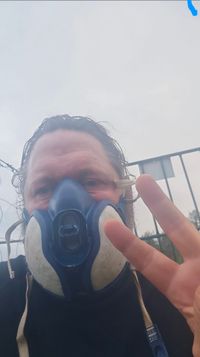
The report says his condition is severe enough that he requires a mask almost continuously and has changed where he lives because of it. That is the basis on which the physician classified his MCS as Grade IV of IV.

Then comes the sentence that changes this from a story about illness into a story about access.

His physician recommends specific safety measures when he must enter environments with a high chemical load, expressly naming hospitals and operating rooms and referring to environmental, medication, food and personal-hygiene precautions.

For Hudson, therefore, a hospital is not simply a building containing doctors.

The environment is part of the medical equation.

And when the environment cannot be adapted, the treatment inside the building can become extraordinarily difficult to reach

6,100 hospitals—and no national MCS map

The United States has roughly 6,100 hospitals, according to the American Hospital Association's 2026 Fast Facts, including 5,121 community hospitals and 1,797 rural community hospitals.

Search those thousands of institutions for publicly documented, dedicated MCS hospital protocols and the record becomes remarkably thin.

This investigation could identify three American institutions that historically developed an MCS-specific clinical protocol or procedure.

Not fragrance-free policies.

Not requests for visitors to avoid perfume.

Not generalized disability policies.

MCS protocols.

That distinction matters.

A fragrance-free policy addresses one potential category of exposure. An MCS hospital protocol can reach into admission, emergency care, room preparation, cleaning materials, medications, pharmacy, sterile supplies, medical equipment, linens, food, staff products, transportation through the building and contingency planning if a reaction occurs.

One of the clearest American examples is Southwest General Health Center in Middleburg Heights, Ohio.

Its 2002 Policy 742: Multiple Chemical Sensitivity Syndrome was not a polite sign asking visitors to skip cologne. It established an interdisciplinary system involving physicians, nursing, sterile supply, environmental services, pharmacy, nutritional services, facilities, social services, security and administration.

Before admission, the protocol called for a private room and advance notice to departments including Environmental Services, Central Sterile, Pharmacy and Nutritional Services. The patient's chart was to be flagged for MCS. Staff caring for the patient were instructed to avoid perfume, scented lotions, hairspray, deodorants and similar products. The patient could use a personal respirator; the protocol addressed transportation through the hospital and required measures aimed at limiting exposures from other patients and visitors.

The accompanying hospital policy went further. It addressed sterile linens, latex-free equipment, room cleaning, remodeling near the patient's room, pharmacy ingredients, IV containers and foods.

That is a hospital attempting to redesign the delivery of care around the patient's environmental limitations.

A second surviving document comes from Mercy Medical Center.

Its three-page Multiple Chemical Sensitivity Protocol, dated Nov. 5, 1999, was distributed to patient-care areas, admitting, environmental services, nutritional services and hospital administration. It instructed the emergency department to separate an MCS patient from other patients and visitors and not leave the patient in the general waiting room. It addressed scented staff products, room cleaning, medical equipment, latex, food and medications.

The surviving copy does not clearly identify which Mercy Medical Center issued it, an important limitation in the historical record.

The third documented American example is different.

In 1998, nurses affiliated with Presbyterian Hospital of Dallas published a peer-reviewed paper in the AORN Journal describing the development of a protocol for environmentally sensitive surgical patients. The paper says these patients required highly individualized perioperative assessment and multidisciplinary planning and that the Dallas hospital had successfully cared for such patients.

That is primarily a surgical/perioperative protocol, rather than the broad hospital-wide emergency and admission system preserved from Southwest General or Mercy.

And that creates a question hidden inside the word access.

Even if an operating room can eventually be prepared for a chemically sensitive patient, how does a profoundly affected patient safely travel there, enter the hospital, move through admission, undergo preoperative testing and remain inside long enough to reach that operating room?

The surgery is only one point on the path.

The patient has to survive the path.
The protocols are older than smartphones

There is another fact that makes the American record difficult to ignore.

The Dallas paper is from 1998.

The Mercy protocol is from 1999.

Southwest General's policy is from 2002.

All three are more than two decades old.

An extensive search of current public material did not locate an updated national registry showing which American hospitals maintain comprehensive MCS admission, emergency and surgical protocols today. Nor did it establish that these three institutions continue operating the historical protocols exactly as written.

That does not prove that only three hospitals in America can accommodate an MCS patient. Hospitals may have unpublished internal procedures. Some may construct individualized accommodations without calling them an MCS protocol.

But from the patient's perspective, that qualification creates its own problem.

A person experiencing a medical emergency cannot search an invisible database.

If the accommodations exist but the patient cannot identify them before the emergency, how accessible are they in practice?

Why “fragrance-free” isn't the answer

American healthcare has begun paying more attention to fragrance exposure. In 2025, the American Medical Association adopted policy recognizing that environmental exposures may substantially limit major life activities for some people with fragrance sensitivity and related disorders, and encouraged healthcare facilities to promote fragrance-free policies where feasible.

That is significant.

It is also not an MCS hospital protocol.

For someone at Hudson's documented level of impairment, eliminating perfume would address only one part of the problem described in his medical record.

A comprehensive protocol potentially has to consider what cleaning agents were used in the room, what the staff washed their clothes with, where the patient waits, which route is used through the building, what medical supplies are opened nearby, what medication excipients are present, what disinfectants are being applied, whether construction or floor treatment is occurring nearby, what materials are touching the patient's skin, and how the patient will be moved if a reaction begins.

The old Southwest General protocol understood that distinction extraordinarily well.

It even instructed personnel on how to move the patient from a vehicle into the hospital and called for vehicle engines to be turned off nearby.

That is the difference between “please don't wear perfume” and an actual medical-access plan.

Then Hudson broke his collarbone

For Hudson, the argument stopped being theoretical on July 1, 2025.

He sustained a displaced fracture of his right clavicle.

His records say surgery was subsequently planned for Aug. 6 at Quirónsalud Cáceres. On July 31, the procedure was postponed while clinical, logistical and safety requirements were addressed. A later hospital letter said his surgical and anesthetic circumstances created increased risk, recommended a facility with intensive-care capability and concluded that Quirónsalud Cáceres could not guarantee the clinical, logistical and safety requirements necessary to perform the operation there.

There were also legitimate clinical complications in the case, including disagreements and concerns involving anesthesia and airway management. The records should not be reduced to a claim that a hospital simply refused to operate because Hudson had MCS.

But the next stage is documented too.

His specialist evaluation formally classified his condition at Grade IV of IV and expressly recommended special precautions in hospitals and operating rooms.

According to Hudson's administrative claim, his insurer Sanitas later told him that after making inquiries with public and private hospitals in Extremadura, no regional center had been identified that could perform the clavicle surgery under the technical and environmental conditions involved. Sanitas indicated treatment might have to be sought elsewhere. That statement is evidence contained in Hudson's administrative filing, not a final judicial finding.

In January 2026, according to the same record, the regional public health service acknowledged Hudson's Grade IV MCS, the complexity of surgical care for MCS patients and the absence of a specific MCS protocol within the service.

The collarbone had become something larger.

It was now a test of what the word accessible actually means.

A treatment can exist without being reachable

The distinction sounds almost absurd until it happens.

The X-ray machine exists.

The surgeon exists.

The emergency department exists.

The anesthesia exists.

The hospital bed exists.

The ambulance exists.

And the patient can still lack a usable route to them.

Hudson's administrative filing describes that problem explicitly. It says a future traumatic, abdominal, neurological, cardiovascular or infectious emergency could require imaging, monitoring, medication, anesthesia, surgery or intensive hospital treatment without an accessible pathway already established.

A broken clavicle gives people time to make phone calls.

A heart attack does not.

A stroke does not.

Sepsis does not.

Internal bleeding does not.

And no emergency physician can make geography disappear.

If the nearest appropriate environment is hundreds or thousands of miles away, identifying it does not necessarily provide meaningful emergency access to a patient whose condition itself makes ordinary travel difficult.

That is the paradox at the severe end of MCS:

The more specialized the environment a patient requires, the farther away that environment may be—and the less capable the patient may be of reaching it.

One Spanish woman's trip to Dallas shows what “travel” can mean

The problem is not hypothetical.

In 2007, Spanish patient Elvira Roda, then 34 and severely affected by MCS, traveled from Valencia to the Environmental Health Center in Dallas for treatment. Spanish reporting says she remained there for roughly eight to ten months. El País reported that treatment was costing between €15,000 and €30,000 a month.

Getting her home became an operation of its own.

In May 2008, Spanish news outlet 20minutos reported that her family said approximately €80,000 was needed for a special flight back to Valencia because ordinary air travel could not provide the environment they believed she required.

Ultimately, businessman Francisco Hernando provided a private aircraft. Contemporary reports described the plane being specially prepared, with purifiers and other measures, and a medical team involved in the journey.

The trip did not produce a simple cure narrative.

Years later, Roda remained severely affected. Her family's own updates said she had improved during Dallas treatment but that the treatment had been interrupted for financial reasons; they continued trying to raise money for additional treatment. One later estimate from the family placed an 18-month Dallas stay at roughly €500,000, excluding private-aircraft transportation.

Other Spanish sources were more skeptical of the Dallas approach. An El País report quoted a Spanish toxicology specialist disputing the need to travel there, and a Spanish environmental-health organization later noted that Roda relapsed after the expensive treatment.

So it would be inaccurate to write that $100,000 was spent on a medical flight from Spain to Dallas and the treatment was simply a waste.

The verified story is more complicated—and arguably more powerful.

A severely affected Spanish woman reached specialized treatment in Dallas, spent months there at enormous cost, required extraordinary arrangements simply to travel home, and remained severely ill afterward.

For someone without a wealthy benefactor and access to a specially prepared private aircraft, the obvious question is:

What then?

Other countries have written the instructions

America's sparse public record does not mean MCS hospital accommodation is impossible.

Spain's Canary Islands public health service issued a detailed MCS healthcare protocol in 2025.

The document explicitly states that people with MCS can experience difficulty accessing healthcare services.

Its hospital section addresses planned admission, room preparation, supplies, healthcare workers, surgery, emergency departments, medical transportation and primary care.

Italian researchers likewise produced a multidisciplinary MCS consensus covering hospitalization and emergency care. It recommends specialized preparation of hospital rooms, staff procedures, pharmacy precautions, ambulance considerations, emergency-department isolation and MCS-specific supplies. The authors described their consensus as one of only a few of its kind worldwide.

That phrase—one of only a few worldwide—matters.

There is no global registry from which anyone can honestly calculate what percentage of the world's hospitals have comprehensive MCS protocols. Therefore it would be irresponsible to declare that virtually every hospital on Earth is inaccessible.

But the available evidence reveals something unmistakable:

Standardized MCS hospital pathways are not ubiquitous. They are scattered.

And scattered medicine presents a unique problem when the illness itself restricts travel.

A contested illness. An uncontested access problem.

Multiple Chemical Sensitivity remains medically controversial.

Researchers continue to debate its mechanisms, diagnostic criteria and treatment, and scientific reviews have emphasized that significant uncertainties remain.

A serious article has to say that.

But scientific disagreement about pathogenesis does not make the accessibility question disappear.

Even older critical medical literature acknowledged that many patients labeled with MCS are functionally disabled.


And Hudson's story does not require a journalist to settle the biological debate.

His individual limitations are documented.

His specialist documented Grade IV of IV MCS.

His specialist documented extremely high inhaled intolerance and major impairment of daily life.

His specialist documented near-continuous mask use.

His specialist documented the need for special precautions in hospitals and operating rooms.

And when he suffered an orthopedic injury requiring surgery, his medical and administrative records document a prolonged struggle to establish a pathway capable of treating him under appropriate conditions.

Whatever medicine ultimately determines about the mechanisms of MCS, the access problem in front of him is real enough to be written down.

How disabled is disabled?

Society usually pictures disability in terms of the obstacles it has learned to recognize.

A staircase.

A narrow doorway.

A missing elevator.

A bathroom that cannot accommodate a wheelchair.

Those barriers are visible.

Hudson's barrier is harder to photograph.

It can be the disinfectant used before he arrives.

The product on someone's clothing.

The room prepared the wrong way.

The route through a crowded waiting area.

The equipment beside the bed.

The ambulance required to reach the hospital.

Or simply the distance between the one place capable of accommodating him and the place where his emergency happens.

The United States can identify roughly 6,100 hospitals on a map.

After an extensive search, this investigation could readily identify only three American hospitals in the historical public record that had developed dedicated MCS clinical protocols or procedures—two broad hospital protocols and one surgical protocol.

That does not establish that there are only three today.

It establishes something different:

There is no obvious national map telling a profoundly chemically sensitive patient where to go.

For most people, an ambulance solves the geography of an emergency. It takes the injured person to the nearest hospital.

For Hudson, proximity alone does not answer the question.

The closest hospital may be the hospital that has no established MCS pathway.

The hospital with experience may be hundreds or thousands of miles away.

And the disability that creates the need for specialized care can simultaneously make the journey toward that care extraordinarily difficult.

This is what disability looks like when it reaches an extreme that ordinary accessibility systems were never designed around.

Not simply being unable to work.

Not simply being unable to enter a restaurant.

Not simply being unable to live in an ordinary house.

But facing a medical emergency and discovering that even society's final safety net requires another safety net beneath it.

There is a hospital.

There is a doctor.

There is an operating room.

There may even be a treatment.

The final question is much smaller.

And much more frightening.

Can the patient get there?

And once he arrives, can he stay long enough to be treated?

MCS Survival Foundation works to raise awareness and advocate for people living with severe Multiple Chemical Sensitivity. Share this story to help make invisible barriers visible..

JOHNNY RAY HUDSON

More Posts

U.S. CITIZEN IN DISTRESS: AN AMERICAN IS DYING IN A FIELD IN SPAINU.S. CITIZEN IN DISTRESS: AN AMERICAN IS DYING IN A FIELD IN SPAIN
U.S. CITIZEN IN DISTRESS: AN AMERICAN IS DYING IN A FIELD IN SPAIN

He is severely disabled. He lives outdoors. He says ordinary buildings can make him dangerously ill, appropriate medical care has become extraordinarily difficult to access, and organization after organization has told him his circumstances are beyond what they can handle. He has asked governments, hospitals, charities, disability groups, churches, friends and family for help. The explanations change. The American remains in the field.

SANTIAGO DE ALCÁNTARA, Spain —

An American citizen is living in a field in Spain.

Read that sentence again.

Not camping.

Not backpacking.

Not spending a summer beneath the stars.

A Broken Bone, a Suspected Disease, and a Health System That Couldn’t Treat BothA Broken Bone, a Suspected Disease, and a Health System That Couldn’t Treat Both
A Broken Bone, a Suspected Disease, and a Health System That Couldn’t Treat Both

His clavicle needed surgery. Doctors suspected Multiple Chemical Sensitivity and required further medical evaluation before the operation could proceed. The diagnosis was ultimately confirmed as severe, Grade IV MCS. But the diagnosis did not return Johnny Ray Hudson to the operating room. More than a year later, the documents surrounding his case tell a larger story about what happens when medical care exists — but a disabled patient cannot reliably access it.

About This BlogAbout This Blog
About This Blog
We write for customers, neighbors, and anyone interested in what we do and how we do it. This is a place to stay connected, learn something new, and get a closer look at what’s happening around our business.